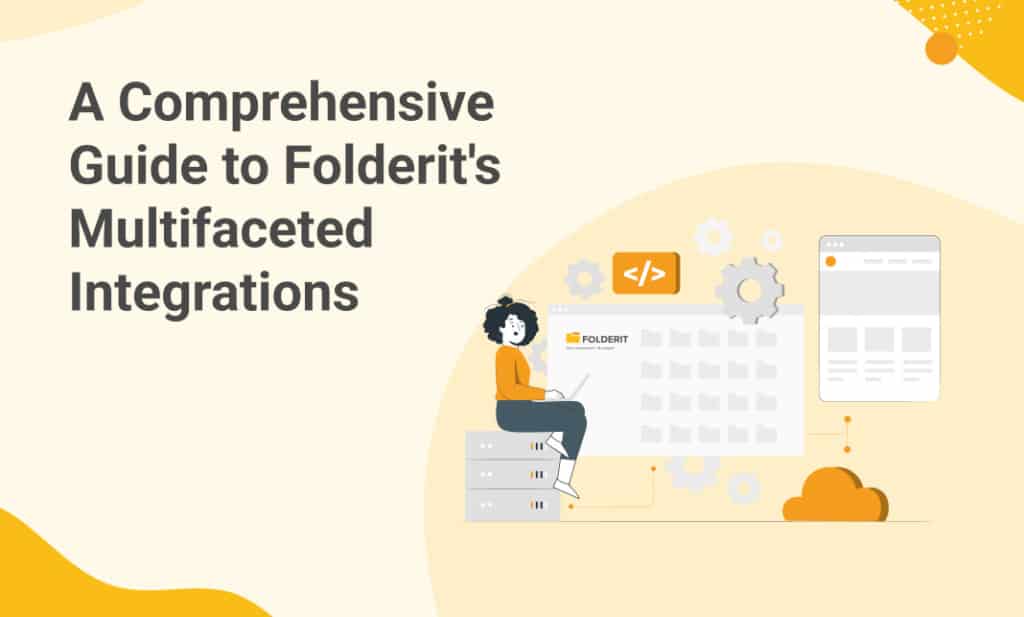
Folderit is a document management system (DMS). Its integrations connect document work to the tools your organization already uses. Some help people edit or collect documents, others manage sign-in, and others connect a document process to an external application.
The right connection depends on the task. Signing in through an identity provider is different from provisioning users; saving an email attachment is different from synchronizing two document libraries. This guide explains the available options and the decisions to make before enabling them.
Microsoft Office 365 and Outlook
The Microsoft Office 365 integration lets users create and edit Office documents directly in Folderit. It is useful when the document should remain part of the Folderit filing and access structure while people work on its content.
The Folderit Outlook add-in lets users save selected emails and attachments to a Folderit folder. For example, an employee can file supplier correspondence beside the relevant invoice or contract. Decide which messages belong in the record and who is responsible for selecting the correct destination.
These capabilities do not, by themselves, mean that every Office or SharePoint location is synchronized with Folderit. If your process needs data to move between systems, define the transfer separately and verify the available connector or API operations.
Single sign-on and user provisioning
Folderit supports single sign-on through Okta SAML, Microsoft Entra ID and Google SAML. Single sign-on lets an organization use its identity provider for authentication.
Folderit also documents Okta SCIM user provisioning. Provisioning manages user lifecycle actions; it is a separate capability from signing in. Do not assume that configuring SAML automatically creates the intended users, removes departed staff or applies every document permission.
Before rollout, test an ordinary user, an administrator and a departing user’s access. Document who owns the identity configuration and check Folderit’s actual folder and item permissions. An identity connection should fit your access model, not substitute for designing it.
DocuSign and electronic-ID signing
The DocuSign integration sends documents stored in Folderit for signature through a connected DocuSign account. It is available on Folderit’s Medium and Tailor plans and requires a separate DocuSign subscription and available envelopes. For the connection steps and workflow choices, see the Folderit DocuSign integration guide.
Folderit also supports electronic-ID signing using supported national identification methods, including ID-card, Smart-ID and Mobile-ID. Method availability and the required signature level should be checked for the people and documents involved.
Folderit’s native electronic-signing method is another option, distinct from the DocuSign integration. Compare the actual signing requirements, recipient experience and plan terms before choosing a method. Connecting a signing service does not make every document compliant with every jurisdiction’s formalities.
Make and viaSocket for application workflows
Make, formerly Integromat, and viaSocket can connect Folderit to other applications. These automation platforms are useful when a process needs actions across systems rather than only within Folderit.
Begin with a specific requirement: which event starts the process, which document or record should move, and what information must accompany it? Then verify that the chosen platform provides the necessary operations. A platform listing does not guarantee that every feature in either connected application is available through its connector.
- Ownership: choose which system holds the authoritative record and which receives a copy or reference.
- Field mapping: define names, dates, currencies and required values before transferring data.
- Duplicate handling: decide what happens when the same event is delivered twice.
- Failures: assign someone to review unsuccessful runs and establish a safe retry process.
- Permissions: confirm what the connection can access and what users can access after a transfer.
Folderit’s knowledge base describes Make and viaSocket as providing automation functionality similar to Zapier and Microsoft Power Automate. That comparison should not be read as a claim that Folderit has a native connector for every one of those platforms.
Microsoft Power Automate and Folderit DMS
The Folderit DMS connector for Microsoft Power Automate brings document management actions into cross-application flows. Microsoft has certified the connector and completed publication on 26 October 2026; Partner Center reports it as Live. Availability can vary during rollout: our latest normal-environment check did not yet show the public connector. Check the Power Automate setup guide for the current availability note and connection steps.
The connector provides 19 actions for accounts, folders, record search, file uploads and downloads, versions, supported metadata, and existing manual workflow starts. It currently supplies actions rather than a Folderit event trigger. Use a manual button, schedule, or event from another connected application to start a flow.
For example, you can build a process to file incoming email attachments, store generated invoice PDFs, create project folders from CRM records, add document revisions, or retrieve a document for the next business step. Configure and test each application’s connection and field mapping. File transfers through this connector currently support up to 10 MiB per file.
Microsoft Copilot and AI workflows
A separately configured Copilot Studio agent can use Folderit actions as tools for document search, metadata lookup, or other selected operations. That agent can be deployed to Teams or Microsoft 365 Copilot using Microsoft’s supported channels. Connector publication does not automatically index the Folderit repository in standard Copilot or install a ready-made agent.
Summarisation, translation, classification, and invoice-value extraction need document-content extraction and an additional AI step, such as AI Builder’s Run a prompt action. These scenarios require their own Microsoft licensing, AI capacity, permissions, and testing. The Copilot section of the setup guide links to the relevant Microsoft instructions.
The Folderit connection uses an authorised user’s existing permissions. Confirm API access and an eligible Microsoft license before rollout. Start with the step-by-step Power Automate guide, or contact Folderit about your document-management process.
WordPress document and e-form plugins
The Folderit document plugin, currently in beta, embeds lists of downloadable files from a Folderit account on a WordPress website. Choose the documents intended for website visitors and test the resulting access before publishing a list.
The Folderit e-forms plugin hosts Folderit e-forms on a WordPress website and sends submitted data to Folderit. Define the destination, fields and follow-up process so a submission becomes an actionable record.
The current integrations knowledge-base page links to the plugin downloads and individual setup guides.
The Folderit API for custom connections
Folderit’s public API documentation provides the starting point for a custom integration. This route is appropriate when the required workflow is specific to your systems or is not covered by an available connector.
Ask the implementer to demonstrate the exact operations your process needs. Agree on access scope, error handling, ownership and maintenance, including what happens if either service changes. An API makes integration possible; building and operating the connection remains a separate piece of work.
Use a proof of concept to choose the right approach
Start with a small set of representative documents and written acceptance criteria. Check the successful path, an invalid input, a repeated event, an unavailable service and a user who should not have access.
For example, a document-transfer test should confirm that the correct file and metadata arrive, that retries do not create unwanted duplicates, and that someone can diagnose a failed transfer. Our DMS proof-of-concept guide helps structure that evaluation.
Use built-in connections where they meet the requirement, automation platforms for supported cross-application steps, and a custom API implementation when the process needs it. Confirm the required Folderit plan and any external subscription before rollout, using the current knowledge-base setup instructions.