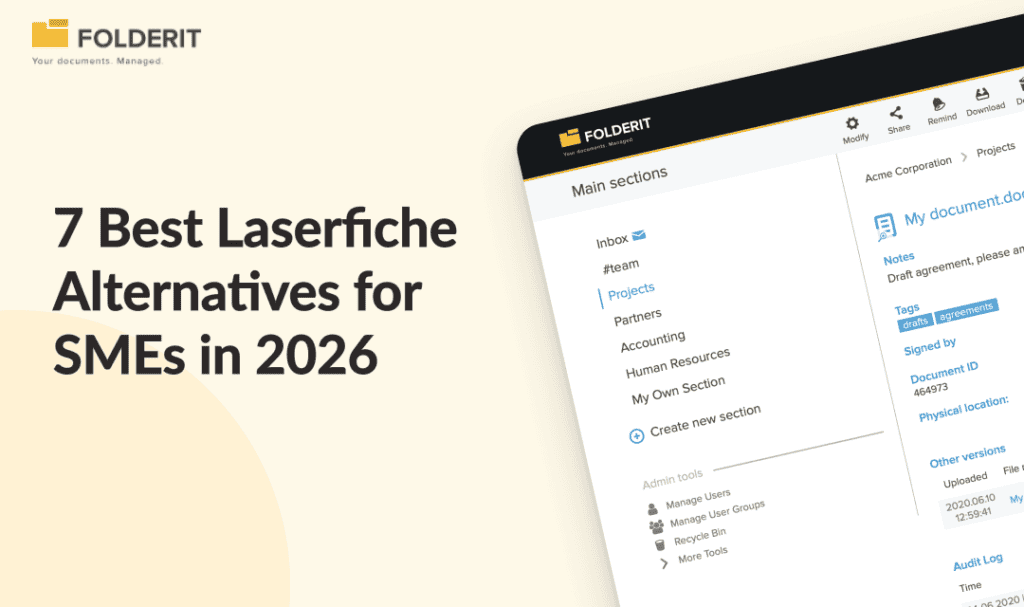
The best Laserfiche alternatives for small and mid-sized businesses are Folderit, DocuWare, M-Files, Hyland OnBase, OpenText, Microsoft SharePoint (configured as a DMS), and Box. If you need compliance-ready document control without enterprise complexity or per-user pricing that scales unpredictably, Folderit is the strongest fit for organisations under 500 employees.
Laserfiche is a capable business process management and document management platform, but many organisations find themselves looking for alternatives due to cost, complexity, or the need for more flexible tools. Organisations seeking Laserfiche alternatives often lack dedicated IT resources to configure and maintain an enterprise ECM, or find that Laserfiche’s pricing structure does not match their headcount model.
This guide compares the seven most credible Laserfiche alternatives available in 2026. Each pick is evaluated on usability, compliance features, deployment speed, and total cost of ownership. By the end, you will know which platform fits your organisation, and which ones to avoid.
Why Are Organisations Looking for Laserfiche Alternatives?
Laserfiche is one of the original pioneers in the document management space. It is an Enterprise Content Management platform built around powerful process automation, and it primarily serves large organisations in sectors like government, higher education, and finance. Laserfiche’s heritage as an ECM platform is also its limitation for most SMEs.
Critical feedback about Laserfiche often centres on its complexity and cost, especially for organisations without dedicated technical staff. Many users note that the system comes with a noticeable learning curve and that some parts of the interface can feel unintuitive, leading to longer-than-expected deployments. Laserfiche’s complexity and deployment timelines are among the most frequently cited concerns.
Pricing is another recurring concern, with some customers finding the platform expensive and the mix of add-on modules or tiered licensing confusing. A lack of clear upfront pricing for larger or on-premises deployments can also frustrate teams trying to budget early in their research.
On the cost side, Laserfiche cloud pricing starts at $50 per user per month.
For 100 users, the monthly cost can range from $5,000 to $7,000. For larger enterprises with 1,000 users or more, the monthly cost can reach $50,000 or higher. Laserfiche’s cost at scale compounds further when implementation is factored in. Small businesses may expect to pay around $5,000 to $10,000 for implementation, while larger enterprises could incur costs upwards of $50,000 or more.
For a business with 50 employees that needs ISO-aligned document control, controlled approval workflows, and an audit trail, that cost and complexity profile is hard to justify.
How We Chose These Laserfische Alternatives
Every platform on this list was evaluated against five criteria that matter most to compliance-conscious SMEs:
- Usability: Can a Quality Manager or HR lead administer it without IT involvement?
- Compliance features: Are audit trails, version control, approval workflows, and retention rules built in, not bolted on?
- Deployment speed: Does it go live in days or weeks, not months?
- Pricing model: Is total cost predictable and proportionate for organisations under 500 employees?
- Security: Does it include 256-bit encryption, SSO, 2FA, and access controls as standard?
Laserfiche Alternatives Compared: Quick Reference
| Platform | Best For | Pricing Model | Deployment Speed | ISO-Ready Out of Box |
|---|---|---|---|---|
| Folderit | Overall & Ease of Use | Per plan | Days | Yes |
| DocuWare | Finance/AP workflows | Per user | Weeks | Partial |
| M-Files | Metadata-driven organisations | Per user | Weeks-months | Partial |
| Hyland OnBase | Large enterprise automation | Custom | Months | Yes (with IT) |
| OpenText | SAP/ERP-integrated enterprises | Custom | Months | Yes (with IT) |
| SharePoint | Microsoft 365 users | Included in M365 | Months (config) | No |
| Box | External collaboration | Per user | Days | No |
1. Folderit: Best Overall and for Ease of Use

Why we picked it: Folderit is the most direct answer to everything Laserfiche gets wrong for smaller organisations. It is a secure, user-friendly document management system that gives businesses controlled document storage, approval workflows, e-signatures, and audit-ready compliance without the complexity of an enterprise ECM platform. Named the most user-friendly DMS in the world by Gartner’s Capterra based on task-completion time benchmarking, it is designed to be administered by business users in Quality, HR, Legal, and Operations, not by IT departments.
Best for: Organisations with 10-500 employees in regulated industries (manufacturing, professional services, healthcare, legal, financial services) that need ISO 9001 or ISO 27001-aligned document control without a six-month implementation project.
Pricing model: Per-plan, not per-user. Each plan includes a set number of seats, so costs grow in steps rather than linearly with every hire which is a meaningful structural advantage over Laserfiche’s per-user billing, where each additional user adds directly to the monthly spend.
Key compliance features:
- Full audit trails logging every action with timestamps (uploads, edits, approvals, sharing, downloads)
- Built-in approval workflows and acknowledgement workflows for policy distribution
- Automated retention rules and document expiration reminders
- Version history and document numbering out of the box
- Document check-in/check-out to prevent conflicting edits
Security: 256-bit AES encryption at rest, SSL/TLS in transit, two-factor authentication, SSO via Entra ID, Okta, and Google, IP restrictions, and triple-redundant backups stored 100km+ apart. All standard, not premium add-ons.
Deployment: Live in days, not months. No implementation consultants required.
Data sovereignty: Headquartered in Estonia/Germany, cloud-hosted on AWS with EU data residency. Also available as single-tenant cloud or on-premises for organisations with strict data sovereignty requirements.
Compliance support: ISO 9001, ISO 27001, GDPR, HIPAA, Cyber Essentials, and 21 CFR Part 11.
Where Folderit wins vs Laserfiche: Folderit deploys in days rather than months, requires no IT team to administer, and prices per plan rather than per user. For organisations that need document control governance without enterprise ECM overhead, Folderit delivers faster time to value at a fraction of the total cost.
Folderit also integrates natively with DocuSign for e-signatures, removing the need for a separate signing tool.
2. DocuWare: Best for Invoice and Accounts Payable Workflows

Why we picked it: DocuWare is a solid mid-market DMS with strong workflow automation, particularly for finance-heavy document processes like invoice routing and purchase order approvals.
Best for: Finance and operations teams that need structured approval chains for financial documents.
Key features: Document capture, workflow automation, metadata tagging, and escalation rules for overdue approvals. For invoice processing, DocuWare can extract key data from invoices automatically, match them against purchase orders, and route them for approval. Administrators can set escalation rules so that overdue approvals are automatically flagged.
Pricing: DocuWare Cloud pricing ranges from £10 to £60 per user per month, depending on the scale of implementation and functionalities required. This per-user model means costs scale directly with headcount.
Where it falls short vs Folderit: DocuWare’s per-user pricing becomes expensive as teams grow. Its compliance feature set for ISO document control is less complete out of the box compared to Folderit, and EU data residency options require more configuration.
3. M-Files: Best for Metadata-Driven Document Organisation

Why we picked it: M-Files takes a metadata-first approach to document management, organising content by what it is rather than where it is stored. This suits organisations with complex cross-departmental document relationships.
Best for: Mid-sized organisations that need to connect documents across multiple business systems and want AI-assisted classification.
Key features: M-Files delivers metadata-driven document management that eliminates information chaos and improves productivity across the document lifecycle. By linking documents to the people, processes, clients, and projects that give them meaning, M-Files creates a unified environment that accelerates decision-making and strengthens governance.
Where it falls short vs Folderit: M-Files carries a higher implementation overhead and is more IT-dependent than Folderit. For organisations that need compliance governance without a complex metadata architecture project, Folderit is faster to value.
4. Hyland OnBase: Best for Large Enterprise Process Automation

Why we picked it: Hyland OnBase is a full enterprise content management platform with deep process automation capabilities. It sits in the same category as Laserfiche in terms of power and complexity.
Best for: Large organisations (500+ employees) with complex, multi-department process automation requirements and dedicated IT resource to manage the platform.
Key features: Hyland OnBase is one of the most commonly cited Laserfiche alternatives in enterprise ECM comparisons, offering document management, workflow automation, and records management at scale.
Where it falls short vs Folderit: Hyland OnBase is not built for SMEs. Implementation timelines typically run six months or more, and the platform requires IT resource to administer. For organisations under 500 employees, the total cost of ownership is disproportionate to the document control problem being solved.
5. OpenText: Best for SAP and Enterprise ERP Integration

Why we picked it: OpenText Extended ECM is the enterprise choice for organisations that need deep integration with SAP, Salesforce, or Microsoft 365 at scale.
Best for: Large enterprises with complex ERP ecosystems and dedicated IT teams managing document infrastructure.
Key features: OpenText stores, manages, and provides access to documents with strict governance and compliance standards. It integrates with major enterprise systems such as SAP, Salesforce, Microsoft 365, and Guidewire, and offers deeper system integrations and AI-powered search than Laserfiche.
Where it falls short vs Folderit: OpenText is a powerful alternative to Laserfiche for enterprises that need deeper system integration, enterprise-grade scalability, and AI-enhanced document intelligence, but it is overkill for any organisation under 500 employees. Deployment complexity and cost are significant barriers for SMEs.
6. Microsoft SharePoint (Configured as a DMS): Best for Organisations Already Deep in the Microsoft 365 Ecosystem

Why we picked it: SharePoint is already deployed in most Microsoft 365 environments, making it a zero-additional-licence option for organisations willing to invest in configuration.
Best for: Organisations with an active Microsoft 365 subscription, a capable IT team, and document management needs that do not yet include formal approval workflows or retention automation.
Key features: Document libraries, version history, basic access controls, and co-authoring via Microsoft 365. Laserfiche itself allows users to collaborate on and edit Microsoft 365 content simultaneously, which illustrates how central Microsoft’s ecosystem is to this space.
Where it falls short vs Folderit: SharePoint requires significant configuration, IT involvement, and third-party add-ons to function as a compliant DMS. Approval workflows, acknowledgement tracking, retention automation, and audit-ready reporting are not available out of the box. Folderit provides all of these features without custom development, making it the better choice for organisations that need compliance governance without an IT project.
7. Box: Best for Secure External Collaboration

Why we picked it: Box is a strong choice for organisations that need to share documents securely with external parties at scale, particularly in regulated industries.
Best for: Organisations with frequent external document sharing requirements, such as legal teams or professional services firms.
Key features: Box is positioned as a leader in intelligent content management, helping teams securely manage, collaborate, and automate their work. It provides one secure platform for the entire content lifecycle, from storing and sharing to signing and automating content. Box enforces advanced security and compliance with HIPAA, GDPR, FINRA, and FedRAMP certifications.
Where it falls short vs Folderit: Box’s strength is collaboration and external sharing, not document control governance. It lacks the built-in approval workflows, acknowledgement tracking, retention automation, and ISO-aligned document lifecycle management that Folderit provides as standard. For teams that need to pass an ISO audit, Box alone is not sufficient.
Is Laserfiche Worth It for SMEs?
Laserfiche is a true enterprise-grade system, but it comes with a different level of complexity and cost compared to more modern, agile solutions. The time and resources required to implement and maintain Laserfiche often exceed the benefits for organisations with straightforward document management needs.
Users consistently find Laserfiche’s steep learning curve challenging, due to its complex components and insufficient documentation, with learning curve and learning difficulty among the most frequently mentioned concerns in user reviews.
For government bodies, universities, and Fortune 500 companies with dedicated IT teams and multi-department automation requirements, Laserfiche earns its place. For an organisation with 20-250 employees that needs controlled document management, approval workflows, and audit-ready compliance, the platform is disproportionately complex and expensive.
What Makes Folderit the Strongest Laserfiche Alternative for Most SMEs?
Folderit was built specifically for the gap that Laserfiche leaves open: organisations that need enterprise-grade document control without enterprise-grade implementation projects.
Here is what that means in practice:
- No IT team required. Quality Managers, HR leads, and Operations Coordinators administer the system themselves.
- Compliance built in, not configured. Audit trails, approval workflows, acknowledgement tracking, retention rules, version history, and document numbering are all standard features, not add-ons requiring a consultant.
- Predictable pricing. Per-plan billing means a team of 50 and a team of 150 do not face a proportionally different bill.
- Deployed in days. Folderit goes live in days or weeks, not months. There is no implementation project to manage.
- EU data residency as standard. Hosted on AWS with EU data residency, with single-tenant cloud and on-premises options for organisations with strict data sovereignty requirements.
- Full audit trail from day one. Every action on every document is logged with a timestamp, giving compliance teams the evidence trail they need for ISO 9001, ISO 27001, GDPR, and HIPAA audits.
For real estate agencies, manufacturing businesses, professional services firms, and any organisation managing controlled documents across teams, Folderit provides the structure and governance that shared drives and Laserfiche both fail to deliver, at opposite ends of the complexity spectrum.
See how Folderit supports document control for compliance-driven teams, or explore Folderit’s document approval workflow to understand how approvals work in practice.