The best document control software for manufacturing depends on your regulatory scope and team size. MasterControl and ComplianceQuest suit regulated manufacturers in life sciences. DocuWare and DELMIAWorks suit teams that need to connect documents to production and ERP processes. Folderit suits SME manufacturers that need ISO-grade version control, approvals and audit trails their quality team can manage without IT support.
An operator on the line picks up a work instruction that was superseded three weeks ago, because nobody removed the old copy from the shared drive. Gaps like that are exactly what ISO surveillance audits and customer audits are designed to catch, and manufacturing document control software closes them by governing how procedures, drawings, work instructions and quality records are created, approved, distributed and retired.
This guide compares seven tools, from life sciences quality platforms and ERP-embedded modules to lighter systems built for smaller manufacturers, and explains what each does well, who it suits, where it falls short and which questions to ask before committing budget.
What should manufacturing document control software include?
Manufacturing document control software manages the full lifecycle of controlled documents, from drafting and review to approval, publication and archiving. Its job is to make sure people on the shop floor see only the current approved version, and to provide evidence of who approved each document and when. ISO 9001 sets out these expectations in its requirements for documented information, and sector standards such as IATF 16949 for automotive, AS9100 for aerospace and ISO 13485 for medical devices build on the same foundation.
Most leading tools cover a similar core set of functions. The differences lie in depth, setup effort and who administers the system day to day. Look for:
- Version control that archives the old revision automatically when a new one is approved
- Approval workflows that route documents to the correct reviewers and record each decision
- A complete audit trail logging uploads, edits, approvals, downloads and sharing with timestamps
- Role-based access, so operators see approved documents only while drafts remain with authors
- Acknowledgement tracking, which proves that staff have read an updated procedure
- Retention rules covering how long quality records are kept and when they are disposed of
- Search, including OCR for scanned certificates, inspection sheets and supplier documents
Auditors look hardest at the audit trail, and our guide to how audit trails create accountability for every document action explains what a good one captures. Smaller manufacturers working toward certification will find a practical walkthrough in our ISO 9001 document control guide for SMEs, and for process fixes that work alongside software, see practical ways to improve your document control process.
Best Document Control Software Tools for Manufacturing: Quick Summary
| Tool | Best For | Standout Feature | Pricing |
| Folderit | SME manufacturers preparing for ISO audits | Built-in approvals, acknowledgements and retention rules | From $55/month, per plan rather than per user |
| DocuWare | Linking production, supplier and invoice records | Digital project file from engineering drawings to delivery notes | Contact for pricing |
| MasterControl | Life sciences manufacturers working under GxP | Document revisions automatically trigger training tasks | Contact for pricing |
| ComplianceQuest | Regulated manufacturers wanting a connected QMS | Document control linked to CAPA, audits, training and change management | Contact for pricing |
| DELMIAWorks | Manufacturers running DELMIAWorks ERP | Documents linked to customers, vendors and BOMs inside the ERP | Contact for pricing |
| Tulip | Digital work instructions on the shop floor | No-code apps that guide operators step by step | Per-interface plans, 30-day free trial |
| isoTracker | Small ISO 9001 teams wanting published pricing | Reminders for upcoming and overdue document reviews | From $984.27/year for 5 users |
The 7 Best Document Control Software Tools for Manufacturing: Our Top Picks
1. Folderit: Best for SME Manufacturers That Need ISO-Grade Control Without the Overhead
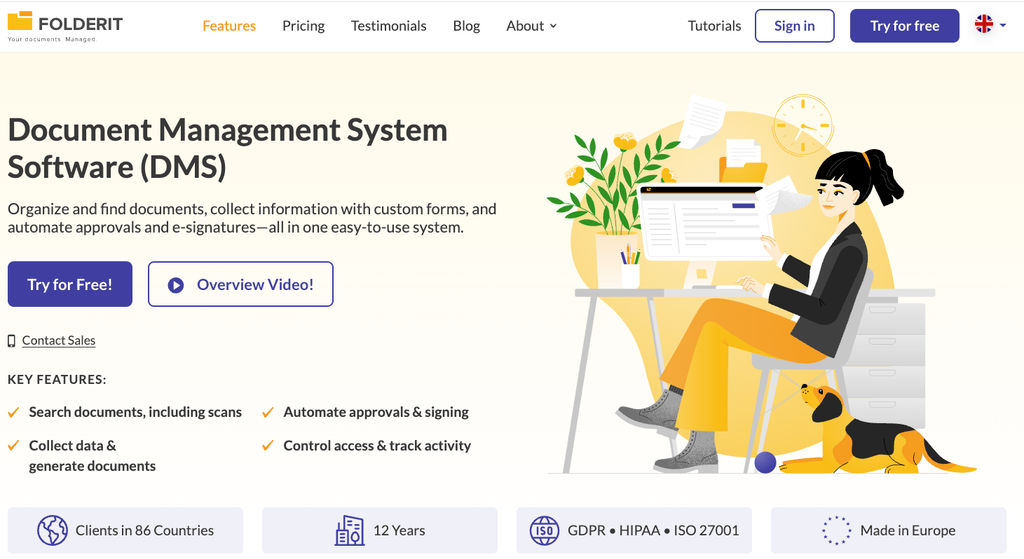
What makes it different: Folderit’s ISO document control software is a document management system with document control built in from the start, covering approval workflows, acknowledgement tracking, automated document numbering, retention policies, version history and full audit trails without add-ons or custom configuration. Quality managers, document controllers and operations leads can administer it without an IT department, and Folderit was named the most user-friendly DMS by Capterra based on ease-of-use benchmarking.
For manufacturing teams, several features matter in daily use:
- Granular permissions such as preview-only access for controlled documents. Operators can read a procedure but cannot download or edit it.
- OCR search and custom metadata, so staff can find a scanned material certificate as quickly as a Word file.
- Microsoft 365 integration for creating and editing Word and Excel documents inside the system. See how Folderit works with Microsoft 365.
- E-signatures through native Folderit eSign or DocuSign.
- Security as standard, including 256-bit AES encryption, SSO via Entra ID, Okta or Google, IP restrictions and two-factor authentication.
Folderit supports ISO 9001, ISO 27001 and 21 CFR Part 11 requirements and is available as multi-tenant cloud on AWS, single-tenant cloud or on-premises. Pricing is per plan rather than per user, starting at $55 per month for the Mini plan, which keeps costs more predictable as more shop-floor staff need read access, although costs step up as you add seats and storage. Most teams go live in days or weeks, and a free trial is available without a credit card.
Best for: Manufacturers of roughly 20 to 250 people that have outgrown shared drives, face ISO audits and want a system their quality team can own.
What to consider: Folderit is a document management system rather than a full QMS suite with dedicated CAPA, nonconformance and supplier quality modules, so manufacturers that want those processes in the same system should look at MasterControl, ComplianceQuest or the DELMIAWorks quality suite. It connects to ERP systems through its REST API rather than through pre-built ERP connectors. Its standard cloud is hosted in the EU, so organizations with specific data location requirements should confirm hosting with Folderit or consider the single-tenant and on-premises options.
2. DocuWare: Best for Linking Production, Supplier and Invoice Documents
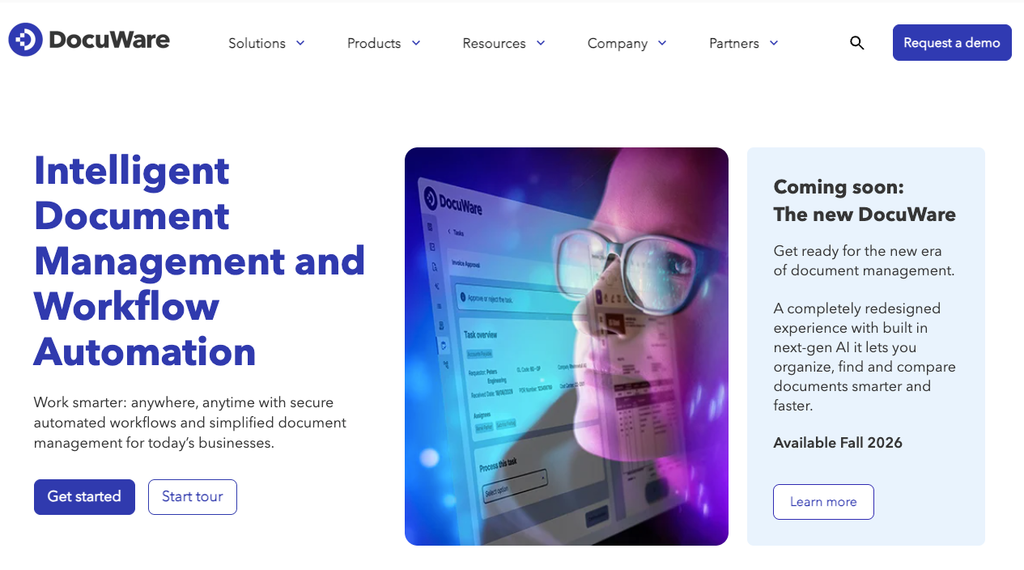
What makes it different: DocuWare brings the documents behind a manufacturing process into one central archive, from design drawings and material orders to production documents, sales orders and invoices. A digital project file groups everything related to a job, from engineering drawings through inspection reports to delivery notes, and version control records who changed each document and when. Workflows route documents to the right approvers, and DocuWare’s manufacturing positioning covers the full cycle from inquiry and production through to delivery and payment.
Best for: Manufacturers that want to digitize document-driven processes across production, procurement and finance on one platform.
Where DocuWare falls short: DocuWare does not publish pricing, and deployments are typically sold and supported through its network of authorized partners, so cost and implementation quality depend on the partner you choose. Its manufacturing strengths center on order, production and invoice workflows, so quality teams should check specifically how it handles controlled document release, periodic review and read-and-understood acknowledgement. Teams comparing options can see our roundup of DocuWare alternatives.
3. MasterControl: Best for Life Sciences Manufacturers Under FDA and GMP
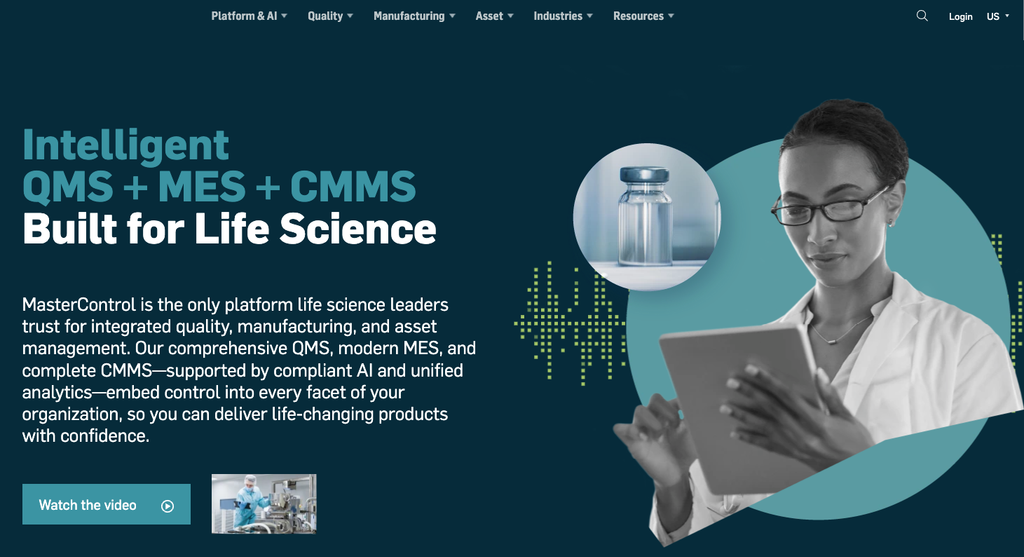
What makes it different: MasterControl Documents automates document routing, delivery, escalation and approval, and tracks changes during revision so reviewers can see exactly what moved. When a document becomes effective, previous versions are archived automatically, and revisions trigger training tasks for the employees affected, which links document control directly to training records. MasterControl has supplied document control software to hundreds of life sciences companies, and its platform extends into CAPA, audit and risk management.
Best for: Pharmaceutical, biotech and medical device manufacturers working to FDA and wider GxP expectations.
Where MasterControl falls short: MasterControl does not publish pricing, and its design is shaped around life sciences validation and compliance requirements. General manufacturers working to ISO 9001 may find its scope and implementation effort greater than their audits require.
4. ComplianceQuest: Best for Regulated Manufacturers Wanting an AI-Assisted QMS
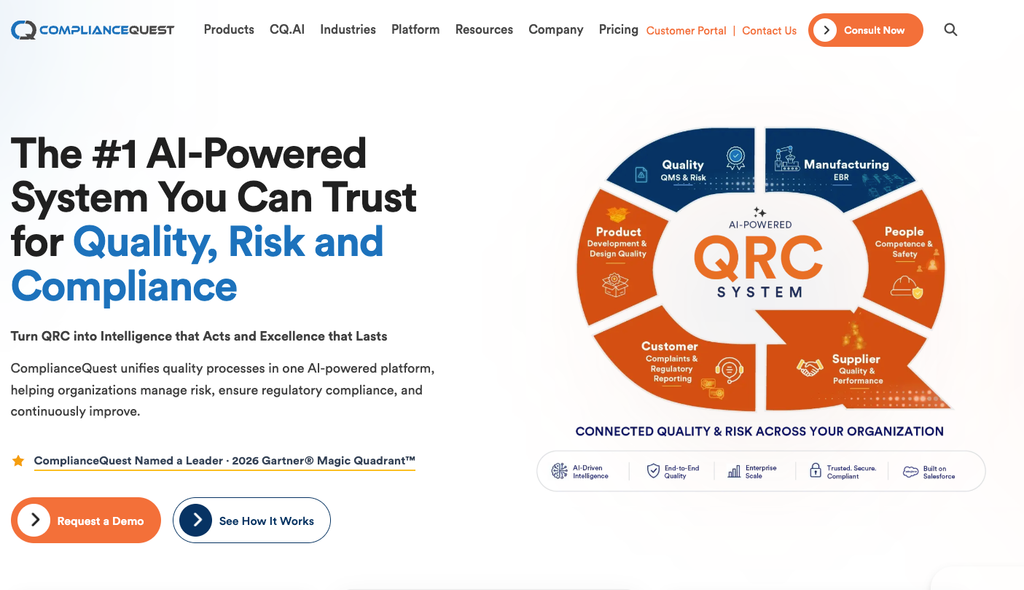
What makes it different: ComplianceQuest’s document management system is built natively on Salesforce and connects document control with CAPA, audits, complaints, training and change management, so changes to a procedure can be traced through the quality processes that depend on it. The vendor describes its platform as AI-powered and designed to meet FDA 21 CFR Part 11, ISO 13485 and global GxP requirements, with electronic signatures, audit trails and validated workflows. ComplianceQuest reports that most customers go live in four to six weeks.
Best for: Regulated manufacturers that want document control as one connected module in a broader quality, risk and compliance system.
Where ComplianceQuest falls short: Pricing is quoted rather than published, and because the platform runs on Salesforce, its integration and reporting advantages are greatest for organizations already using Salesforce. Manufacturers that only need to fix document control may find a full quality suite more than they need.
5. DELMIAWorks: Best for Manufacturers Already Running DELMIAWorks ERP
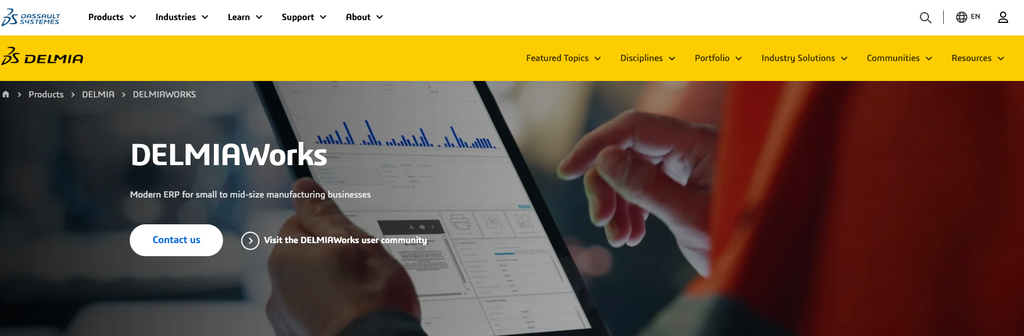
What makes it different: DELMIAWorks, formerly IQMS and now a Dassault Systèmes brand, includes document control within its manufacturing ERP alongside ECO/ECN and CAR/CAPA quality tools. The Document Control module manages documents from creation and approval through implementation and obsolescence, keeps old revisions on file and links documents to customers, vendors, BOMs and inventory records. Workflow notifications can also bring customers and suppliers into the review and authorization process, and the quality system supports automotive, FDA 21 CFR Part 11 and ISO requirements.
Best for: Manufacturers that already use, or plan to adopt, DELMIAWorks as their ERP.
Where DELMIAWorks falls short: Document control is only available as part of the DELMIAWorks ERP, so it is not an option for manufacturers running a different ERP, and adopting a new ERP for document control alone would be a major project. Pricing is not published.
6. Tulip: Best for Digital Work Instructions on the Shop Floor
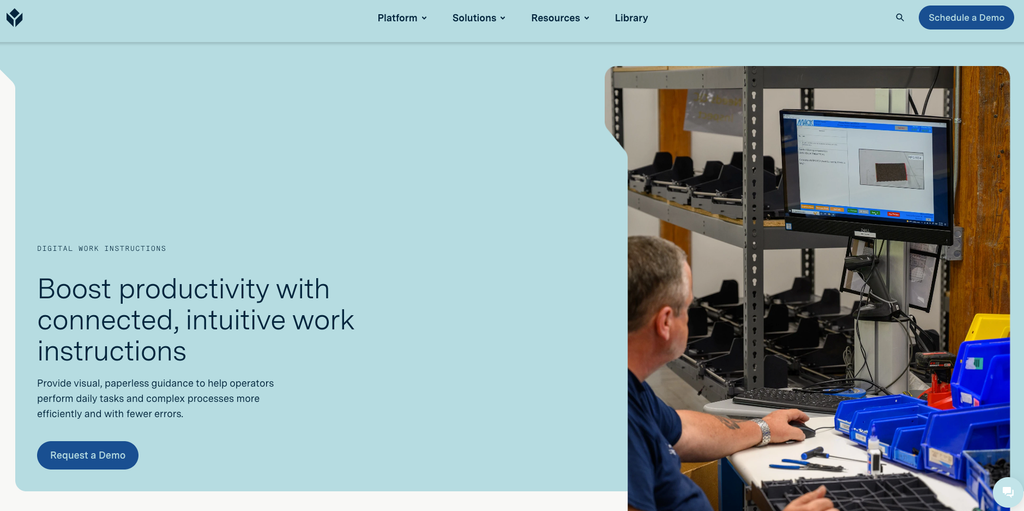
What makes it different: Tulip is a no-code frontline operations platform that manufacturers use to build apps guiding operators through assembly, inspection and other tasks step by step, with images, video and embedded quality checks. Apps run on workstation touchscreens, tablets, phones and wearables, and connect to machines and other systems to capture production data at the source. Tulip charges per active interface rather than per user and offers a 30-day free trial of its Essentials plan without a credit card.
Best for: Manufacturers that want work instructions delivered and enforced at the point of use, with operator actions and quality data captured as work happens.
Where Tulip falls short: Tulip is an app-building platform rather than a controlled document repository, so someone on the team needs to build and maintain the apps, and procedures, drawings and quality records that sit outside those apps still need a home. Tulip operates only as a SaaS solution, with no on-premises deployment.
7. isoTracker: Best for Small ISO 9001 Teams Wanting Published Pricing
What makes it different: isoTracker’s Document Control module provides cloud-based version control for electronic documents, and its version 4.0 upgrade added a mobile-optimized design, reminders for upcoming and overdue document reviews, view-only access for selected users and support for up to two Super Admins. isoTracker publishes its pricing in several currencies, with the document management module starting at $984.27 for five users over 12 months, which makes budgeting straightforward for small quality teams.
Best for: Small manufacturers running an ISO 9001 quality management system that want transparent, package-based pricing.
Where isoTracker falls short: SSL encryption is charged separately at a fixed $188.30 per package, and pricing scales by named-user package, so costs rise with every additional operator who needs access to controlled documents. Other quality modules, such as audits and corrective actions, are also licensed separately.
Which document control software is right for your manufacturing business?
The right manufacturing document control software should match your regulatory framework, your team’s capacity to run it and the auditor questions you need to answer. Start with the framework.
If you manufacture medical devices or pharmaceuticals, a life sciences platform such as MasterControl or ComplianceQuest is built for that work. If your priority is connecting documents to orders, suppliers and invoices, DocuWare or an ERP-embedded option such as DELMIAWorks may feel more natural.
Most SME manufacturers sit elsewhere. They hold ISO 9001, perhaps alongside ISO 14001, IATF 16949 or AS9100, and face familiar problems: outdated procedures on the floor, approvals chased by email and a week of scrambling before every audit. A document tracking system that replaces spreadsheet-based control solves much of that, a dedicated document controlling system adds the approval and acknowledgement evidence auditors ask for, and the right access model reduces mistakes, as our guide to reducing human error in the workplace explains.
Three questions tend to settle the decision quickly:
- Who will administer the system every week: IT or the quality team?
- Can you export audit evidence for a specific procedure in minutes?
- Will pricing still make sense when 150 operators need read access?
For a closer look at what auditors expect, read how document management systems support audit preparation.
How We Chose These Tools
We assessed each tool against the requirements manufacturing auditors check most often: version control with automatic archiving of superseded revisions, approval workflows with recorded decisions, audit trail depth, role-based access and search. We also considered fit, including the industries each vendor serves, whether the tool runs independently or inside an ERP or QMS suite, and who can realistically administer it.
Product details come from each vendor’s documentation and product pages. If a vendor does not publish pricing, we say so instead of estimating it. We excluded tools that we could not verify from primary sources. Folderit appears in this list because it is our product. We assessed it using the same criteria as every other tool and identified where another option may suit you better.
FAQs
What is the best software for document control?
The best document control software depends on your regulatory scope. Life sciences manufacturers often choose MasterControl or ComplianceQuest for GxP work, while SME manufacturers focused on ISO 9001 tend to prioritize ease of use, built-in approvals and full audit trails, which is where Folderit fits. Our guide to document control software features and how to choose covers the evaluation criteria in more depth.
Is there free manufacturing document control software?
Free file storage tools can hold documents, but most do not record the approval evidence, acknowledgements or retention rules that ISO auditors request. A better option is a free trial of a dedicated system. Folderit offers a free trial without a credit card, allowing quality teams to test approval workflows, version history and audit trails on real procedures before committing, and Tulip offers a 30-day trial for teams focused on shop-floor work instructions.
Is Folderit right for manufacturing document control?
Folderit suits manufacturers of roughly 20 to 250 people that need ISO 9001-aligned document control, including versioned procedures, approval workflows, acknowledgement tracking, retention automation and full audit trails. Business users can administer it without an IT team, and pricing is per plan rather than per user. Manufacturers that want CAPA, nonconformance and supplier quality in the same system, or that need a full life sciences QMS, may prefer a dedicated quality platform.