The best contract generation software for most small and mid-sized businesses is Folderit, because it combines template-based document generation with approval workflows, e-signatures, and full audit trails at a flat per-plan price. Enterprises with complex, high-volume contracting should consider Ironclad or Icertis, while sales-led teams already using DocuSign should consider DocuSign CLM.
Every contract your team drafts manually is a chance to paste the wrong clause, reference a superseded template, or lose track of who approved what. Contract generation software removes that risk by producing agreements from controlled templates, then routing them through structured approval and signing flows. This guide compares 8 platforms across pricing, deployment effort, and governance features, so you can match a tool to your team size and compliance requirements rather than buying enterprise software you will never fully use.
Best Contract Generation Software Tools for Businesses at a glance
| Platform | Pricing | Deployment Effort | Governance Features |
| Folderit | Flat per-plan pricing | Low (deploys in days without IT) | Full audit trails, visual approval workflows, retention automation, version control, native eSign |
| Ironclad | Custom enterprise pricing | High (enterprise setup, steep learning curve) | AI-assisted drafting, clause and template engine, negotiation workflows |
| DocuSign CLM | Custom enterprise pricing | Moderate to High (enterprise CRM integration) | Standardized templates, clause engine, CRM data merge, approval routing, AI search |
| Icertis | Custom enterprise (starts ~$25–$50/user/mo base) | High (enterprise-grade implementation) | AI Copilot, real-time risk analysis, clause extraction, obligation management |
| ContractPodAi | Custom enterprise pricing | High (tailored for enterprise legal departments) | AI-driven contract authoring, clause-level automation, template management |
| Contractbook | Opaque / tier pricing | Low to Moderate (fast browser-based setup) | Workflow automation, customizable templates, integrated eSignature |
What Is Contract Generation Software (And How Is It Different from e-Signature Tools)?
Contract generation software creates agreements from pre-approved templates, merging in party details, terms, and clauses automatically instead of relying on manual copy-paste drafting. It helps legal and business teams create contracts faster and more accurately by automating document generation, clause selection, and formatting, with users relying on templates and pre-approved clauses to assemble consistent, compliant contracts.
An e-signature tool only handles the final signing step. Contract generation covers what happens before and after: drafting from templates, internal approval routing, version history, and retention. Strong platforms provide governed libraries, version control, and automated clause suggestions to reduce risk, enforce policy, and accelerate high-volume drafting. If your current process is “edit last quarter’s Word file and email it around”, generation software is the fix, not another signing app.
The 8 Best Contract Generation Software Tools: Our Top Picks
1. Folderit: Best for SMBs That Need Generation Plus Document Control
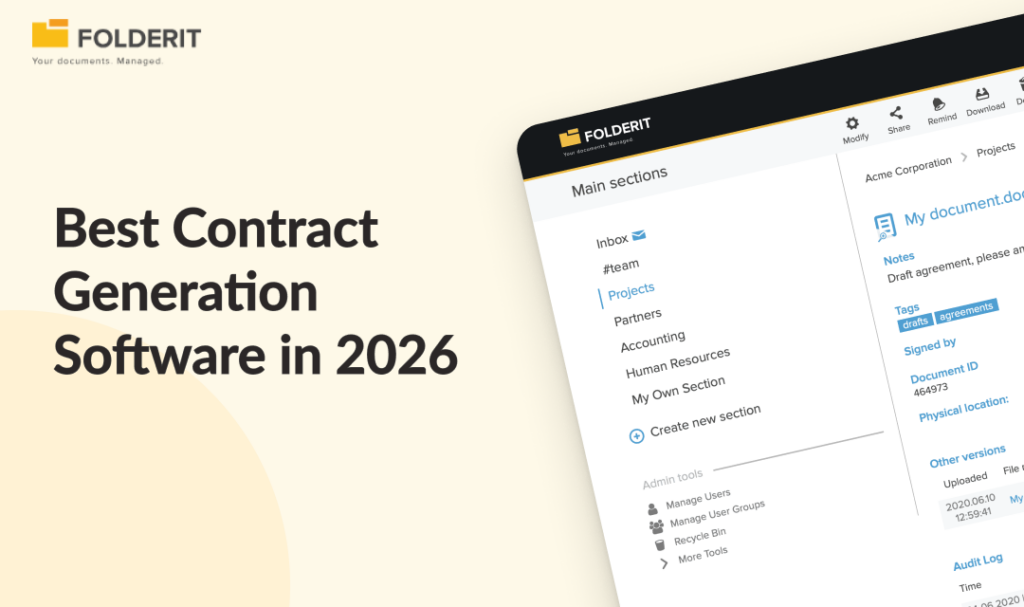
Why we picked it: Folderit is a document management system with a built-in document generator, which means contracts are created from controlled templates and then live inside the same system that handles approvals, e-signing, access permissions, retention rules, and audit trails
Most contract tools generate the agreement and stop there. Folderit governs the entire lifecycle, from draft to signature to archive, in one place.
Best for: Businesses with 10-500 employees in compliance-sensitive industries (manufacturing, professional services, legal, finance, healthcare) that need contract generation without a 6-month CLM implementation.
Key features:
- Document generator with templates and metadata: produce standardised contracts from form templates, with custom metadata fields for counterparty, value, renewal date, and status
- Approval workflows and e-signing: visual workflow builder for internal approval routes, plus native Folderit eSign and a DocuSign integration for external signing
- Full audit trail: the system logs every upload, edit, approval, share, and download with timestamps, so “who approved this version” is never a guess
- Retention automation and version control: superseded contract versions stay accessible, and retention rules run automatically
Pricing: Flat per-plan pricing rather than per-user, which keeps total cost predictable as your team grows. See the Folderit pricing page for current plans, with a free trial available.
Folderit deploys in days, not months, and legal, operations, or quality staff can administer it without IT. For a deeper look at how a DMS handles the contract lifecycle, read Folderit’s guide to how document management systems simplify contract management.
2. Ironclad: Best Enterprise AI Contract Platform
Why we picked it: Ironclad is an AI-powered contract lifecycle platform that automates generation, negotiation, and management of contracts, and it consistently tops enterprise CLM rankings. One 2026 comparison rated it 9.0/10 on features while noting a 6.5/10 for ease of use, which reflects the trade-off: deep capability, steeper learning curve.
Best for: Enterprise legal teams with high contract volumes and budget for implementation.
Key feature: AI-assisted drafting and negotiation workflows built on a clause and template engine.
3. DocuSign CLM: Best for Salesforce-Driven Contracting
Why we picked it: DocuSign pairs its market-leading eSignature with CLM, a clause and template engine, and AI-powered search, letting teams standardise templates, auto-generate agreements from CRM data, route approvals, and sign at scale.
Best for: Cross-functional organisations that need ubiquitous eSignature and strong Salesforce-driven contract generation, particularly where legal, sales, and procurement all need to standardise on one platform.
Key feature: CRM data merge, so sales contracts generate directly from opportunity records. If you are weighing signing platforms specifically, Folderit has compared Folderit eSign vs Adobe Sign vs DocuSign in detail.
4. Icertis: Best for Complex, High-Volume Enterprise Workflows
Why we picked it: Icertis Contract Intelligence is an enterprise-grade CLM platform specialising in AI-powered contract generation, authoring, negotiation, and management, with an AI Copilot that automates contract creation, extracts obligations, and provides real-time risk analysis.
Best for: Large enterprises with complex, high-volume contract workflows needing integrated generation, negotiation, and eSignature capabilities.
Pricing note: Custom enterprise pricing, typically starting at $25-50 per user per month for base CLM features, with add-ons and integrations increasing costs significantly.
5. ContractPodAi: Best for AI-Driven Legal Authoring
Why we picked it: ContractPodAi is an enterprise CLM solution with AI-driven contract authoring, template automation, and clause management. It suits in-house legal departments that want AI review layered on top of generation.
Best for: Legal teams prioritising AI contract intelligence over lightweight usability.
Key feature: AI-assisted authoring with clause-level automation.
6. Contractbook: Best Browser-Based Drafting for Startups
Why we picked it: Contractbook focuses on contract generation in the browser, with a clean modern UI and integrations across the startup tooling stack. It offers customisable templates for NDAs, MSAs, and sales agreements, workflow automation for approvals and send-for-signature, and integrated eSignature with no separate signing tool required.
Trade-off to know: Reviewers note limited reporting, opaque pricing, and complications around third-party contracts.
Best for: Early-stage SaaS teams generating standard agreements at moderate volume.
7. ContractSafe: Best Simple Repository with Renewal Alerts
Why we picked it: ContractSafe is repository-first rather than generation-first, but it earns a place for teams whose main pain is finding signed contracts. It does a focused job well: centralised contract repository, automated renewal and expiry alerts, fast setup, and flat-rate pricing, suited to teams whose contracts are scattered across inboxes and shared drives.
Best for: Small teams that need organised storage and renewal alerts without enterprise overhead.
Pricing note: Starts around $450 per month flat.
8. PandaDoc: Best Per-User Budget Option for Sales Documents
Why we picked it: PandaDoc covers proposals, quotes, and contracts in one document builder with templates and e-signing. It sits in the affordable tier at around $35 per user per month, making it accessible for small sales teams.
Best for: Sales teams generating proposals and simple contracts, rather than legal teams needing governed clause libraries.
How Much Does Contract Generation Software Cost?
Contract generation software ranges from under $20 per user per month to six-figure enterprise contracts, and the pricing model matters as much as the sticker price. According to Capterra, contract lifecycle management software pricing ranges from $7 to over $700 per month based on users, contract volume, and functionality. At the top end, enterprise CLM tools cost $15,000 to $100,000 per year.
Watch for hidden costs beyond the licence. Buyer-reported implementation for contract management platforms commonly runs three to six months and $10,000 to $100,000 or more. Enterprise CLM platforms such as DocuSign CLM, Ironclad, Conga, and Sirion require custom quotes and often carry meaningful implementation costs on top of licensing.
This is where per-plan pricing changes the calculation. Folderit charges by plan, not by seat, so adding your fifteenth or fiftieth user does not multiply the bill. For SMBs, that difference alone often decides the shortlist.
How We Chose These Tools
We evaluated each platform against five criteria weighted for small and mid-market buyers:
- Generation capability: template quality, data merge, and clause control
- Governance: approval workflows, audit trails, version history, and retention (the features that decide audit outcomes, explained in Folderit’s glossary entry on what an audit trail is in document management)
- Deployment effort: days versus months, and whether IT involvement is mandatory
- Total cost of ownership: licence model, implementation fees, and add-on pricing
- Usability: whether non-legal staff can generate and route contracts without training
Tools that generate contracts but leave them ungoverned afterwards scored lower, because the post-signature phase (storage, access control, renewal, retention) is where most compliance failures happen. Folderit covers the strategy side of this in its guide to key elements of an enterprise contract management strategy.
Contract Generation Software FAQs
What is the best contract generation software for small businesses?
Folderit is the best contract generation software for small and mid-sized businesses because it pairs template-based document generation with approval workflows, native e-signing, audit trails, and retention automation at a flat per-plan price. It deploys in days and does not require IT staff to administer.
What is the difference between contract generation and contract lifecycle management (CLM)?
Contract generation is the drafting stage: producing agreements from approved templates. CLM covers the full lifecycle, including negotiation, approval, signing, storage, and renewal. AI contract drafting software differs from basic document automation by combining generative drafting, clause intelligence, and negotiation support within governed legal workflows. Many SMBs get full-lifecycle coverage from a document management system instead of a dedicated CLM.
Can I use a document management system instead of dedicated contract software?
Yes, if the DMS includes generation and workflow features. Folderit handles contract templates, metadata, approval routing, e-signatures, and retention in one system, which replaces separate drafting, signing, and storage tools for most SMBs. Folderit’s guide to improving contract administration with document management explains the approach.
Is Folderit right for enterprise legal teams with complex negotiation workflows?
Folderit fits organisations of 10-500 employees that need controlled contract generation, approval evidence, and audit readiness. Enterprises running high-volume, multi-party negotiations with AI redlining requirements should choose Ironclad or Icertis, accepting the longer implementation and higher cost that come with them.