Mandatory Digital Waste Tracking begins for licensed and permitted waste receiving sites in England and Wales on 1 October 2026. Scotland and Northern Ireland follow from 1 January 2027.
For organisations affected by the new requirements, preparation involves more than choosing how information will be submitted. Businesses also need to consider how waste data is captured, who checks it, where supporting evidence is stored and how reporting deadlines will be monitored.
The following practical steps can help waste organisations prepare their processes before mandatory reporting begins.
1. Confirm Which Sites and Waste Receipts Are in Scope
Start by establishing exactly where the Digital Waste Tracking requirements apply within your organisation.
The first phase applies to organisations receiving controlled waste at licensed or permitted sites. Businesses operating several sites should review each relevant permit or licence and determine which waste receipts need to be reported.
Do not assume that every operation will be treated in exactly the same way. There are exclusions and specific rules for certain activities, so the latest government guidance should be checked against your actual operations.
2. Identify the Information You Will Need to Report
The Report Receipt of Waste service requires structured data rather than simply a scanned document.
Depending on the waste involved, information can include:
- Waste movement details
- Waste carrier information
- Waste receiver information
- Waste classification codes
- Recovery or disposal codes
- Hazardous waste information where applicable
- Persistent organic pollutant (POP) information where applicable
Review where each piece of information currently originates. Some may already exist in operational software, while other information may come from Waste Transfer Notes, weighbridge systems, carrier information, laboratory data or manual entry.
3. Map Your Current Waste Receipt Process
Before changing software, document how a waste receipt is currently handled from arrival to final record keeping.
For example:
- Waste arrives at the site.
- The load is weighed or otherwise measured.
- Carrier and waste information is checked.
- Supporting paperwork is received or created.
- The waste receipt is recorded in an operational system, spreadsheet or other record.
- Documents are filed or scanned.
- Required reporting is completed.
This exercise can reveal where information is duplicated, entered manually, stored in different systems or only available on paper.
4. Decide How You Will Submit Digital Waste Tracking Data
Businesses should establish how their Receipt of Waste information will reach the UK Digital Waste Tracking service.
One option is to use compatible software connected to the Defra Receipt of Waste API. A spreadsheet-based submission route is also available.
If you already use specialist waste management software, ask the provider:
- Will the software support the Report Receipt of Waste service?
- Will submissions be made directly through the Defra API?
- When will the integration be available?
- How will rejected or invalid submissions be handled?
- Where will the resulting Waste Tracking ID be stored?
- How will users identify records that have not yet been submitted?
Knowing the submission route early gives you time to test the process rather than discovering gaps shortly before the mandatory date.
5. Organise Supporting Documents
Digital reporting does not remove the need to manage the evidence behind waste movements.
During the initial introduction of Digital Waste Tracking, existing documentation requirements continue where applicable, including documents such as Waste Transfer Notes, hazardous waste consignment notes and Annex VII forms.
Waste organisations may also need to manage:
- Weighbridge tickets
- Permits and licences
- Waste carrier documentation
- Classification information
- Photographs
- Sampling or laboratory information
- Correspondence and emails
The goal should be to make it easy to retrieve the documentation associated with a particular waste receipt rather than storing the structured record and its evidence in unrelated locations.
6. Create a Consistent Digital Record
If receipt information is currently captured differently by different employees or sites, now is a good time to standardise it.
A structured record can provide defined fields for the required information instead of relying on free-text descriptions, individual spreadsheets or inconsistent file names.
This can also make validation easier. Required fields can be identified before the record reaches the person responsible for submitting it.
7. Decide Who Is Responsible for Each Step
Technology alone will not ensure that reporting happens on time.
Define who is responsible for:
- Creating or capturing the waste receipt record
- Checking waste classification information
- Adding supporting documentation
- Reviewing the information for completeness
- Submitting the record
- Resolving validation errors
- Monitoring outstanding or overdue submissions
Where several people are involved, a defined workflow can reduce uncertainty about who needs to act next.
8. Plan for the Two-Working-Day Deadline
For waste received in England and Wales, the required information must generally be submitted within two working days, starting on the day after the waste is received.
That makes outstanding submissions something organisations need to be able to see clearly.
Consider how your process will identify:
- New waste receipts awaiting review
- Records missing required information
- Records awaiting submission
- Failed or rejected submissions
- Successfully submitted records
Relying on employees to remember individual deadlines becomes increasingly risky as submission volumes increase.
9. Plan for Validation Errors and Missing Information
Not every record will necessarily be ready for submission when it is first created.
Information may be missing, incorrectly formatted or fail service validation. Your process should make it clear what happens when a submission cannot be completed successfully.
Ideally, users should be able to identify the problem, correct the information and resubmit the record while retaining a history of what happened.
10. Prepare for Service Outages
Your internal process should not depend entirely on the Digital Waste Tracking service being available at the exact moment a waste receipt is processed.
Defra provides rules for situations where an outage prevents information from being submitted. Organisations can still be required to make and retain a written record of the relevant information within the normal reporting period and submit it after the service becomes available again.
This makes it useful to maintain your own complete record independently of the submission itself.
11. Test the Process Before It Becomes Mandatory
Do not make the first mandatory waste receipt your first end-to-end test.
Run realistic examples through the proposed process before the deadline:
- Create the receipt record
- Add or associate its supporting documents
- Review the required data
- Test the submission process
- Check how validation errors are presented
- Confirm where the returned reference is recorded
- Test how another employee can later retrieve the complete record
Testing with real-world scenarios is more useful than checking only whether individual fields exist.
12. Train the People Who Will Use the Process
Employees responsible for waste receipts need to understand both the reporting requirement and the organisation’s own process.
Training should cover what information needs to be captured, where documents belong, who is responsible for review, what the reporting deadline is and what to do if information is missing or a submission fails.
A simple and consistent process is generally easier to follow than relying on detailed instructions to compensate for a fragmented system.
A Simple Digital Waste Tracking Readiness Checklist
- We know which sites and waste receipts are affected.
- We know what structured information must be captured.
- We know where each required piece of information originates.
- We have chosen how records will be submitted.
- Supporting documents are stored consistently.
- Waste records can be connected to their supporting evidence.
- Responsibility for review and submission is clear.
- Outstanding submissions can be identified before their deadline.
- There is a process for errors and rejected submissions.
- There is a process for service outages.
- The full process has been tested.
- Relevant employees have been trained.
Using Folderit for Digital Waste Tracking Preparation
Folderit can provide the document and records management layer behind a Digital Waste Tracking process.
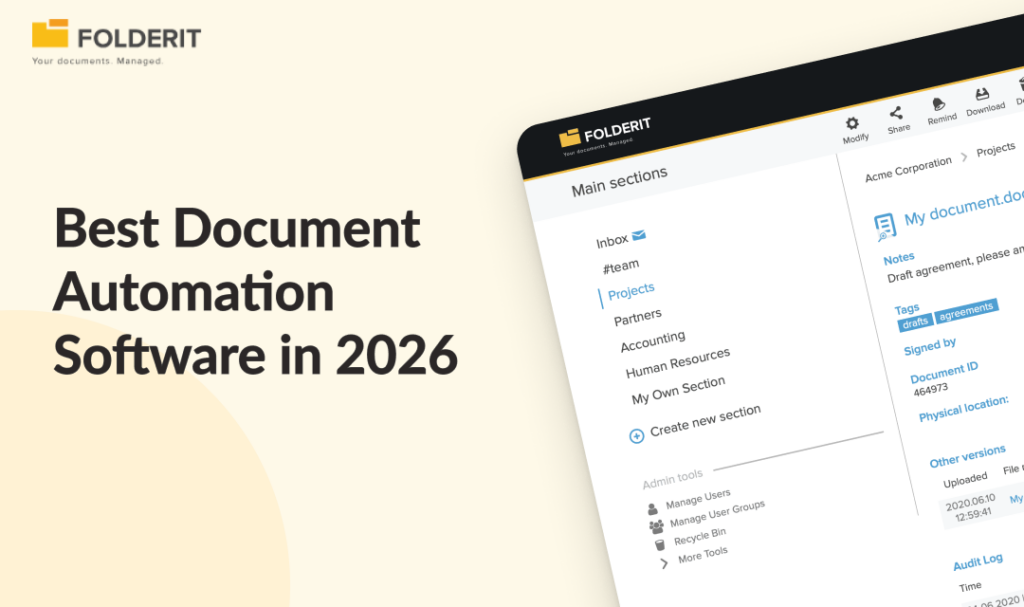
Structured waste receipt information can be captured using Folderit eForms, while supporting documents such as Waste Transfer Notes, consignment notes, weighbridge tickets, permits and photographs can be securely stored alongside the relevant records.
Workflows can be used for review and approval steps, while permissions, audit trails, document version history and retention management provide controls for the wider compliance record.
Folderit is also preparing support for the Defra Receipt of Waste API. The planned integration will allow authorised users to submit structured Receipt of Waste information and store the returned Waste Tracking ID and validation result with the corresponding record.
Direct submission through Folderit is currently in development and Folderit is not yet listed by Defra as a compatible software provider.
See how Folderit can support UK Digital Waste Tracking and watch a demonstration of the proposed process.
Start Before the Deadline
For organisations in England and Wales, 1 October 2026 is not the date to begin designing a Digital Waste Tracking process. It is the date the first mandatory reporting requirements take effect.
Using the preparation period to standardise records, organise supporting evidence, define responsibilities and test the submission process can make the transition significantly easier.
Organisations in Scotland and Northern Ireland have until 1 January 2027 before the first mandatory Receipt of Waste requirements begin, but the same preparation principles apply.