Searching
There are two search modes in Folderit: Live Search and Deep Search (with OCR and more).
LIVE SEARCH gives you quick live results as you type something to the search input field, without clicking on the Search button. Only the results that are found in file and folder name and metadata will be displayed as live results.
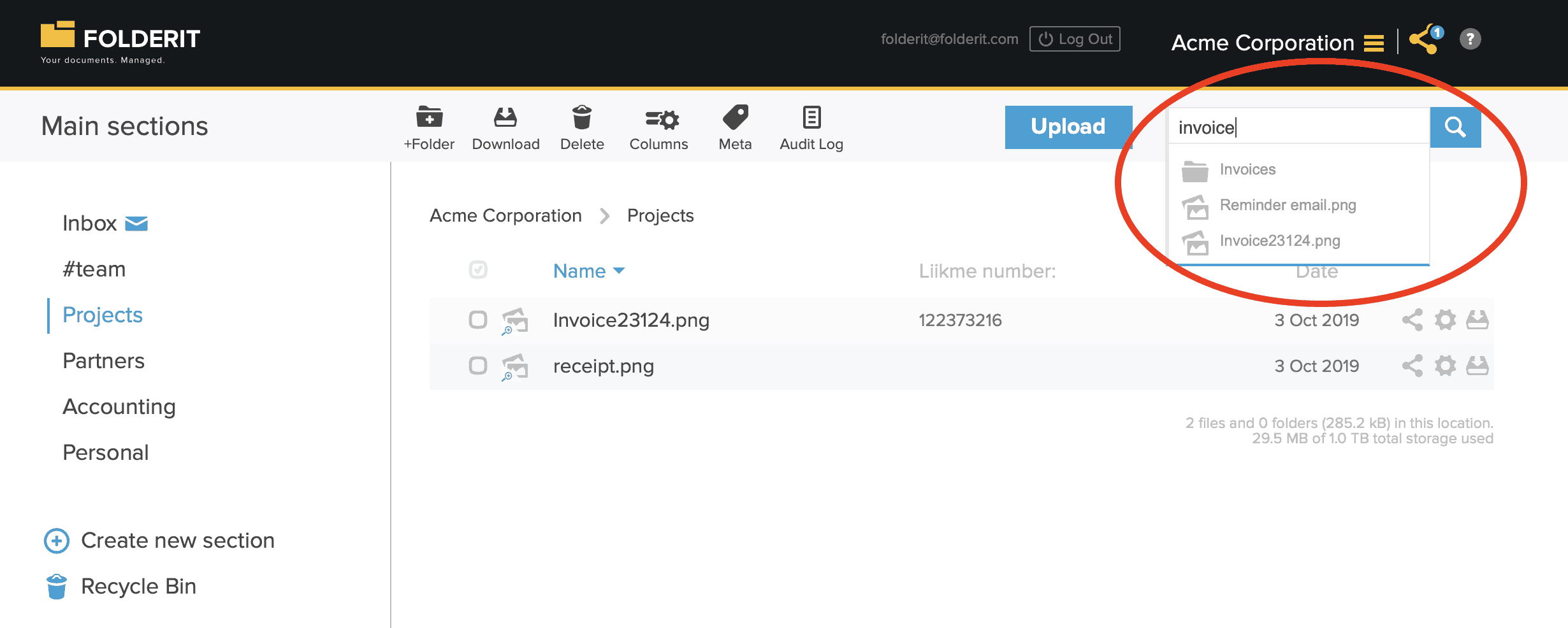
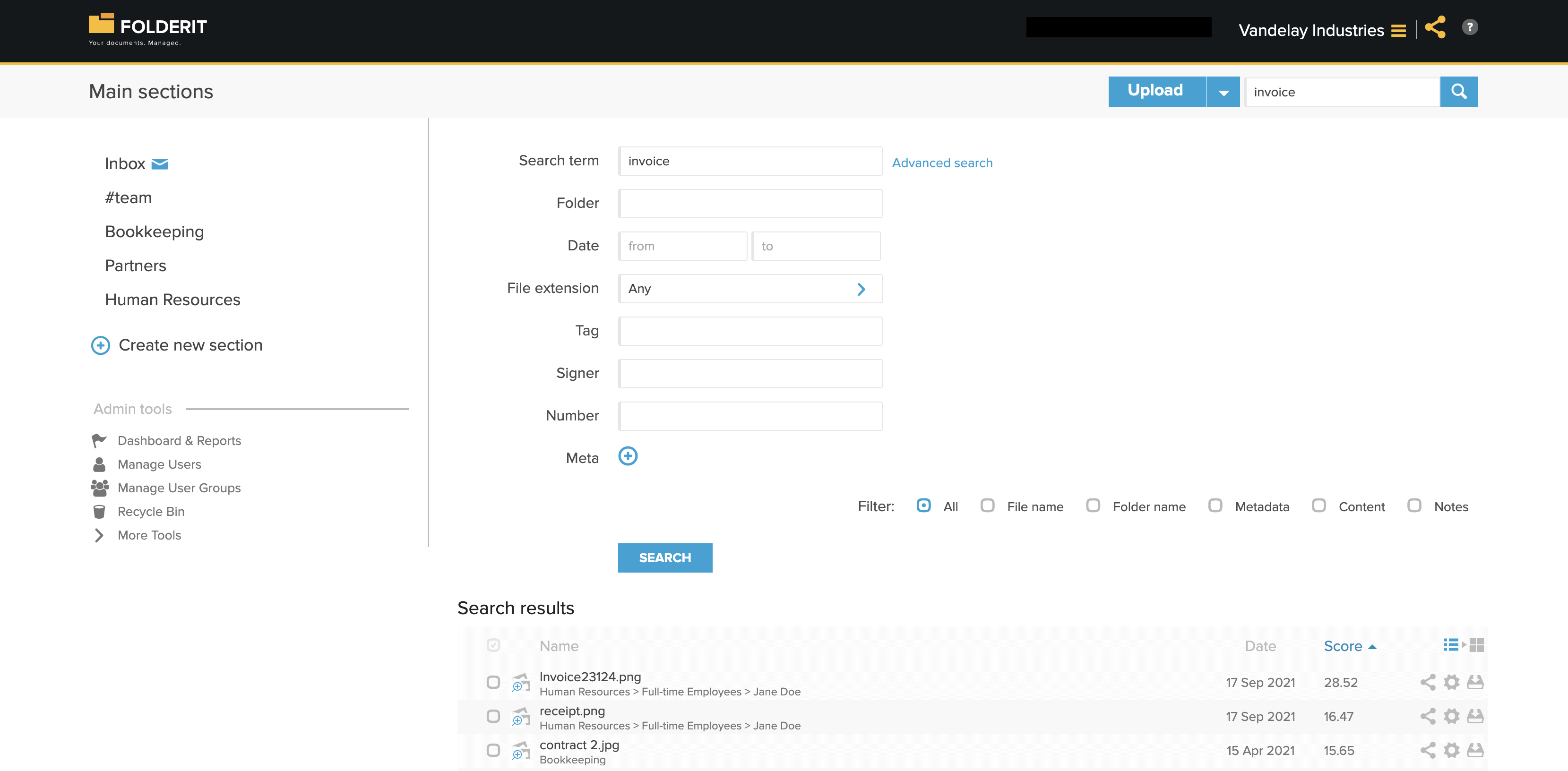
DEEP SEARCH can be accessed when you click on the Search button (magnifying glass). Now search will be conducted from file content (with the help of Optical Character Recognition or OCR technology) in addition to metadata and file/folder names. OCR-powered content search will find search terms from PDF, Docx and other text documents (not .xlsx), but also from PNG and JPG images that include text — from scans or photographs of paper documents for example.
You can change your documents’ language setting for OCR search. Here’s a list of all languages supported by OCR.
In Deep Search mode you can also filter the result to display only results from file names, folder names, metadata, content (OCR) or notes. By clicking on the Advanced Search button more search refinement tools open. Advanced Search allows you to search within a date range, file extensions (where only the extensions your files in Folderit actually have are displayed), Tags, Signers, Dicument Number and from your own custom metadata fields.
Examples of Searches you can do
“search phrase” / +phrase / +”search phrase 2″ <– Search results must include the term
-phrase / -“exclusion phrase” <– Search result must not include the term
You can reorganize the search results by file name, date and score by clicking on the column titles.
Score displays the OCR content search confidence — the higher the score the more likely the search query exists in the file content. Since OCR-technology is a sort of artifical intelligence, it will have to have a certain tolerance allowed to interpret characters it recognizes from the document content. This is needed for some off-angle photographs of text documents, poor lighting conditions etc that will make text appear hard to recognize for the OCR engine.
To exclude an account from OCR indexing go to Manage Accounts > Settings (gear icon) > Modify and uncheck the checkbox “File Indexing”.
* You can also download the files from search results, share the resources, use file previewing etc like in a regular list view.
* To Export search results with metadata as an Excel or CSV file, scroll down to the footer of the search results.
* If you want to share a search link with a cleaner interface, you can add &hideForm=1 at the end of your search query URL. This removes the search input fields, displaying only the search results. Anyone with access to the data in Folderit will see the search results directly, without the extra search form at the top.
* To disable clickable file names in search results, add the parameter &disableLinks=1 to the end of your search query URL. This ensures that users can only preview files from the search results list without being able to open them directly.